When Words Aren’t Enough: How Artmaking Can Help Ground Us and Make Meaning
Dear Courageous Soul,
Sometimes grief has no words.
After a suicide loss, thoughts can become repetitive. We may feel shock, anger, guilt, denial, or we may disconnect from ourselves and the world around us.
Sometimes talking is too much.
This is where artmaking can help
Making marks on paper, choosing colors, shapes, tearing paper for a collage, or simply noticing how a material feels in our hands can gently bring our attention back to the present. Using art for grounding can help us reconnect with ourselves and become more aware of our bodies in the space around us. For a few moments, our repetitive thoughts weaken.
My hands are here.
The paper is here.
I am here.
This is where I often begin.
My approach comes from my training and experience as an art therapist, mindfulness practice, my years of working with trauma survivors, and my own experience of living through suicide loss.
Art Gives Us Another Language
An image, a color, a line, or the movement of our hands can express something we are not ready to put into words.
You do not need to be good at art.
This kind of artmaking isn't about creating something beautiful. There is no right or wrong way to do it. Simple materials are enough: paper, markers, watercolor paints, old magazines, glue sticks.
When we have experienced traumatic loss, we don't need to force ourselves deeper into painful memories before we're ready.
For now, notice the pencil moving across the paper, the sound of the marker, the feeling of fabric between your fingers. The rhythm of weaving, the brush moving through water and paint can help ground you in the present moment.
Over time, art can hold more.
We may create to remember the person we lost, express guilt or anger, explore our connection with them, find compassion for ourselves, or begin making meaning from a loss that has changed our lives.
There is no timetable for getting there.
You are the best interpreter of your own art.
I might ask:
What was it like for you to make this?
What do you notice when you look at your work?
Did you notice any sensation in your body while you were creating?
Sometimes we discover something through these questions.
Sometimes we do not.
Sometimes making marks is enough to distract and soothe.
Try a Scribble Drawing
The image in this post is my example of a Scribble Drawing, a simple artmaking process with roots in the earliest days of art therapy.
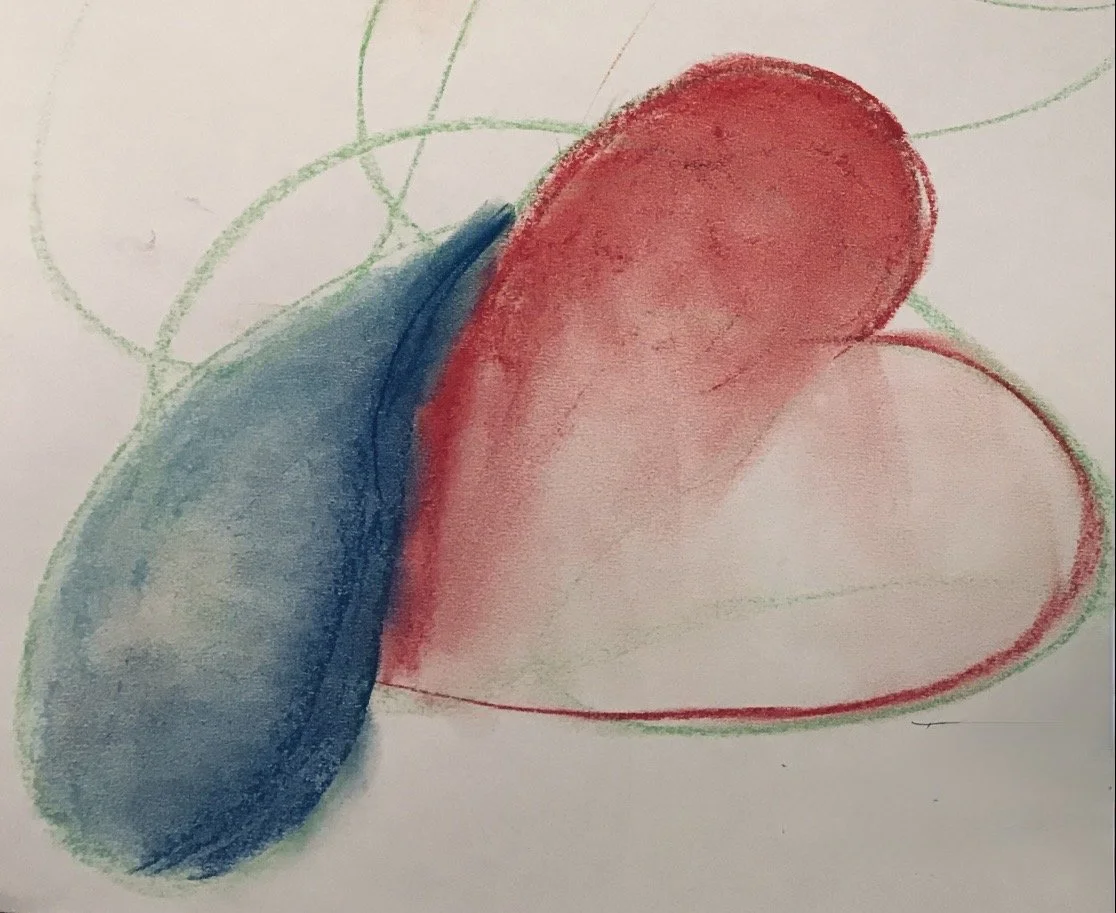
Example of my Scribble Drawing
Allowing an image to emerge
Allow your hand to move freely across the paper and create a spontaneous scribble. You are not trying to draw anything.
When you are finished, turn your paper and look at the scribble from several directions.
Do you notice an image beginning to appear?
If so, follow it. Add color, lines, or patterns. Give it a title or write a few sentences about what emerged.
If you do not see an image, that’s ok, too.
Stay with the scribble. Notice the movement of your hand, the sound of the drawing tool against the paper, and the marks appearing in front of you.
The Experience Itself can be the Purpose.
Florence Cane (1882–1952), an early influence in art therapy, used scribbling to encourage spontaneous movement, creativity, and self-expression. Her sister, Margaret Naumburg (1890–1983), later used scribble drawings therapeutically to explore thoughts and emotions that could emerge through the images.
In my work, I return to something very simple in Cain’s approach:
A hand moves across a piece of paper.
A line follows.
For a few moments, our attention follows the line instead of the thoughts racing through our minds.
We are Here, In This Moment
Later, when we are ready, art may take us somewhere deeper.
But we don't have to begin there.
Sometimes healing begins simply by making a mark on a page.
If this way of approaching grief speaks to you, please feel free to reach out for a gentle conversation.
Sending you lots of hope, compassion and courage,
Janice
References
American Art Therapy Association. About Art Therapy.
Cane, F. (1951). The Artist in Each of Us. London: Thames & Hudson.
Naumburg, M. (1966). Dynamically Oriented Art Therapy: Its Principles and Practice, Illustrated with Three Case Studies. New York: Grune & Stratton.
